Social Sports Night Ideas That Fill Empty Summer Mid-Week Slots
Quiet Tuesday and Wednesday nights don't fill themselves. Here's how to pick a casual mid-week format, price it with worked numbers and promote it so the same faces turn up every week.
On this page
It's 7.15pm on a Tuesday in January. Your lights are on, two courts sit empty, and the only sound is the drinks fridge. If you've been hunting for social sports night ideas that actually turn quiet nights into regular turnout, the answer usually isn't a cleverer idea. It's a simpler format, a price people don't have to think about, and promotion that turns one visit into a weekly habit.
Why quiet mid-week nights stay quiet
Most empty mid-week slots aren't empty because nobody wants to play. They're empty because playing takes too much organising.
To hire a court, someone has to find nine mates, agree on a night, book it, pay for it and chase everyone for their share. That person exists in every friendship group, and they're tired. Your summer comp has already absorbed the keen teams. What's left are the people who'd play if someone else did the organising.
A social night solves that. You do the organising once, and individuals or half-teams just turn up. The usual fixes, like dropping casual hire prices on quiet nights, don't touch this problem. A cheaper court still needs a ringleader.
If you're looking at the wider question of your whole off-peak timetable, we've covered that in filling off-peak court time with open sessions and social play.
Social sports night ideas that suit a mid-week slot
Here are the formats we see work on a weeknight. Each suits a different crowd, so pick based on who's already walking through your door.
| Format | How it runs | Best for | Watch out for |
|---|---|---|---|
| Drop-in open game | Individuals book a spot, teams are made on the night | Singles, new to the area, shift workers | Needs a host who can balance teams fast |
| Mini social league | Teams of 5–7 enter a short block, light ladder | Groups of mates who want a bit of stakes | Forfeits if the block is too long |
| Beginners or returners night | Short games, a quick skills warm-up, no ladder | Lapsed players, mixed groups, first-timers | Keen players turning up and dominating |
| Round-robin night | Teams play everyone once in short games | One-off nights, work groups, end-of-block finals | Tight timing; one slow game backs up the night |
| Bring-a-mate night | Regulars bring a newcomer at a reduced rate | Growing an existing group | Only works once you have regulars |
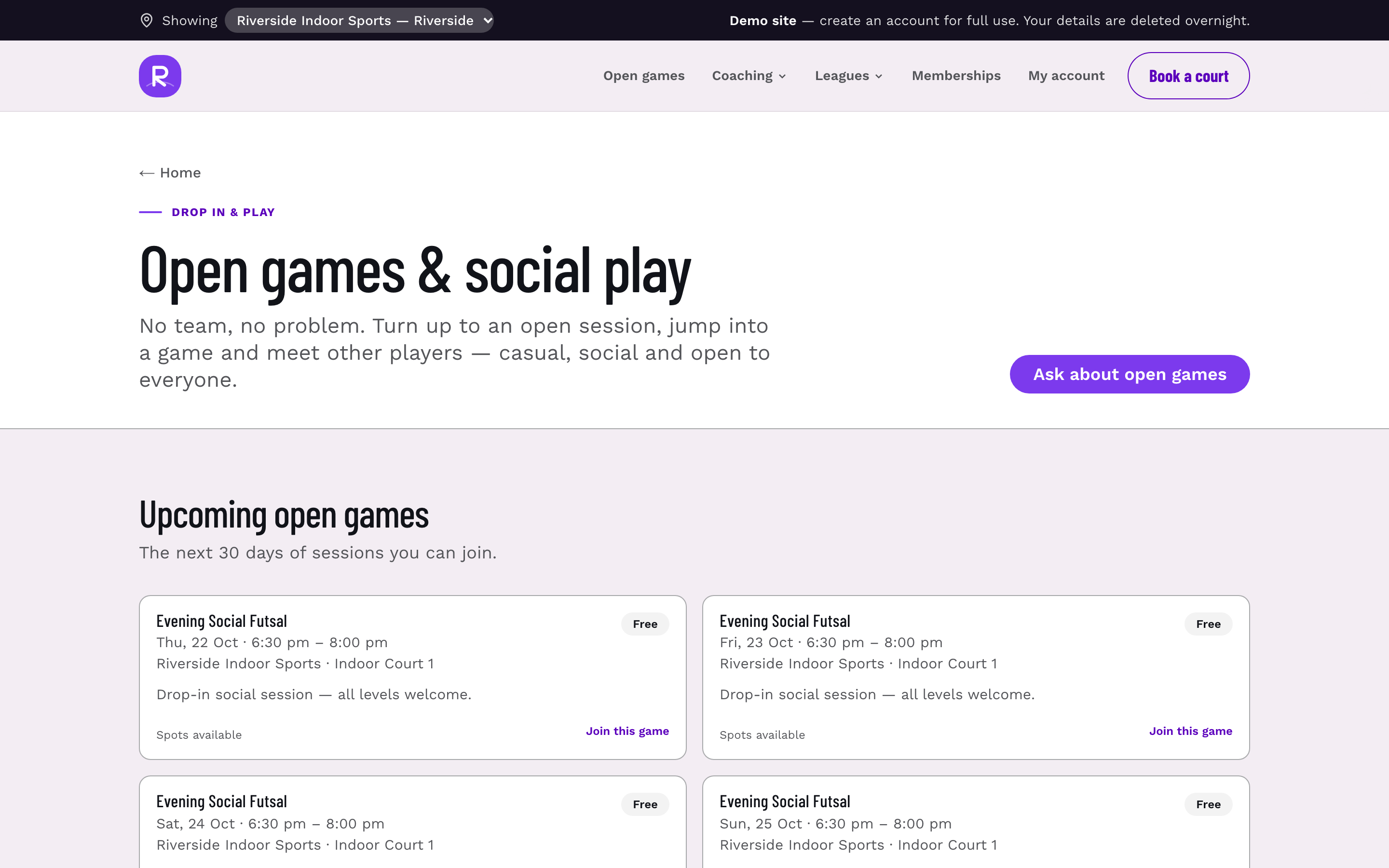
The drop-in open game is usually the best starting point on an empty night. It has the lowest barrier, and once a core group forms, you can graduate them into a mini league.
Commit to one format for a fixed block
The fastest way to kill a social night is to run it once, see eight people, and quietly drop it. Habits take a few weeks to form, so commit before you launch.
A setup that works:
- One night, one time, one format. Tuesday 7–9pm, drop-in 5-a-side. Not Tuesday this week and Thursday next.
- A fixed block of six to eight weeks. Long enough for word of mouth, short enough that people aren't signing up for forever. It also gives you a natural review point.
- A start date people can see. "Starts Tuesday 13 January" sells. "Coming soon" doesn't.
- A minimum you'll run with. Decide in advance that you'll run the night with, say, 12 players, even if it's three-a-side on a short court. Cancelling week two tells everyone not to bother with week three.
If you go the mini league route, keep it short and keep the rules light. A five-week block with a final night beats a twelve-week season nobody finishes. Our guide to forfeit rules a competition can defend is worth a read before you write yours.
How to price a social sports night
Price it per player, keep the number round, and take payment when people book. A round number means nobody's fishing for coins at the desk, and upfront payment is the single biggest lever on whether people actually show.
Here's a worked example. Assumptions: a drop-in 5-a-side night on two courts, 7–9pm, $12 per player, a cap of 48 players (eight teams of six), and one casual staff host costing about $90 for the shift including setup and pack-down. Your staffing costs will differ, so plug in your own and check the award that applies to your staff.
| Week | Players booked | Revenue at $12 | Host cost | Contribution |
|---|---|---|---|---|
| Launch week | 18 | $216 | $90 | $126 |
| Week three | 30 | $360 | $90 | $270 |
| Settled | 42 | $504 | $90 | $414 |
The comparison that matters isn't against a busy Saturday. It's against what those courts earn now on a quiet Tuesday, which is often nothing. Even the launch-week row puts money on the board.
A few pricing moves that build habit rather than just revenue:
- A block pass. Sell the six-week block for the price of five nights. You get the cash upfront and the player has a reason to come back in week four.
- A bring-a-mate rate. A reduced first-night price for a newcomer booked by a regular. Your regulars become your promoters.
- No walk-in discount. If walking in on the night is the same price or cheaper than booking, nobody books and you can't plan teams. Keep walk-ins at full price, or don't take them.
For a mini league, price per team for the block and collect it before night one. The thinking in early-bird pricing and what a deadline does applies here too: a clear close date gets entries in.
This is the part where your booking system earns its keep. With Sweepa's online bookings, open games take payment at the time of booking, show spots remaining and cap themselves when full, so the night is planned before anyone arrives.
What a good social night looks like on the floor
A pattern we see a lot: the night lives or dies in the first ten minutes.
Players arrive between 6.45 and 7.05. Some know each other, most don't. If the host is behind the desk sorting payments, people stand around on their phones and the first game starts at 7.20. Next week, two of them don't come back.
The nights that stick look different. Payment's already done online, so the host is on the floor with a list and a bag of bibs. Teams are balanced on the spot, mixing new faces with regulars. First whistle goes at 7.00, not 7.15. Games are short, around 15–20 minutes, so a lopsided matchup is over before anyone gets annoyed, and teams get reshuffled at the halfway mark.
At 8.55 the host tells everyone the date of next week's game and that booking is open now. That one sentence is your best piece of marketing.
In summer, have a plan for hot nights and storms on outdoor courts. Our hot weather cancellation policy guide covers what to decide before the first 35-degree evening.
How to promote the night so people come back
You don't need an agency or a big ad spend for this. You need to tell the right people, at the right time, with a date and a link.
Start with who you already have. Your past casual hirers, comp players and anyone who's booked a party are the warmest audience you'll ever get. One email and one SMS two weeks out, with the night, the time, the price and a booking link, will do more than a week of social posts.
Ask your comp players directly. Plenty of people in your summer comp would happily play a second night but won't organise it. Mention the social night in your comp messages and on your fixtures page.
Make it findable. Put the night on your website with a booking link that works on a phone. If someone hears about it from a mate, they should be booked in under a minute.
Send the right messages around each night:
- Monday: "Tuesday social — 10 spots left" to past attendees.
- Tuesday afternoon: a reminder to everyone booked, with the start time and what to bring.
- Wednesday: "Next Tuesday's open now" to everyone who played.
That Wednesday message is the one most venues skip, and it's the one that builds the habit. Sweepa's email and SMS go out from the same system that holds the bookings, so you're messaging the people who actually played, not a stale list.
For broader local promotion once the night has a core group, see how to promote a sports venue locally without an agency.
Common mistakes that kill a new social night
- Changing the night or time mid-block. Consistency is the product.
- Cancelling on low numbers. Run it smaller instead.
- Taking payment at the door. It slows the start and lets people no-show for free. Our post on reducing booking no-shows goes further on this.
- Letting a strong team run the night. Rebalance teams. A social night that feels like a grand final loses its beginners fast.
- No graduation path. When a group of regulars wants more, offer them a mini league or a spot in your next comp. If you run comps, competition management in Sweepa handles fixtures and ladders so a social league doesn't add a spreadsheet to your week.
- Measuring by week one. Judge the night at the end of the block, by how many people came back, not by the launch turnout.
Your launch checklist for the next four weeks
Four weeks out
- Pick the night, time and format.
- Set the per-player price, block pass price and bring-a-mate rate.
- Decide your minimum numbers and your hot-weather or wet-weather call.
Three weeks out
- Create the bookable session with a cap and upfront payment.
- Add it to your website with a phone-friendly booking link.
- Line up a host who's good with names and quick at balancing teams.
Two weeks out
- Email and SMS past hirers, comp players and party bookers.
- Mention it in your comp communications.
Launch week
- Send a reminder the afternoon of the first night.
- Bibs, balls, team list and a whistle ready by 6.45.
- Announce next week's date before people leave.
- Send the "next week's open" message the day after.
If you want to see how plans and limits work before you set this up, everything's on our pricing page with the 30-day free trial. Then pick your night, put a date on it, and send that first message this week.
FAQ
What's the best night of the week for a social sports night?
Usually the quietest night you can commit to every week, often Tuesday or Wednesday. Mondays tend to lose people to the start-of-week slump and Thursdays compete with comps and after-work plans. Check your own booking history and pick the night with the most empty court time that your staff can reliably cover.
Should I charge per player or per team for a social night?
For drop-in formats, charge per player, because the whole point is that individuals can come without organising a team. For a mini social league, charge per team for the block and collect it before the first night. Either way, take payment when people book rather than at the door.
How many players do I need before a social night is worth running?
Set your minimum before you launch, based on what still makes a decent game, such as enough for two small-sided teams on one court. Running a smaller night is better than cancelling, because cancellations early in a block teach people not to bother. Review numbers at the end of the block, not after week one.
How long should a social sports block run?
Six to eight weeks is a practical length for most venues. It's long enough for word of mouth to build and for regulars to form, and short enough that people are comfortable committing. It also gives you a natural point to adjust the price, format or time.
How do I stop experienced players dominating a beginners or social night?
Have a host balance teams on the night and reshuffle them partway through. Short games help, because a lopsided match finishes before it sours the mood. If a group of strong players keeps turning up, offer them a mini league or a comp spot so they have somewhere better suited to play.
Do I need special software to run a social sports night?
You can start with a sign-up sheet, but it gets hard to cap numbers, take payment upfront and message attendees as the night grows. A booking system that handles capped sessions, online payment and email or SMS saves the host from doing admin at the desk. Whatever you use, the key is that booking and paying takes under a minute on a phone.